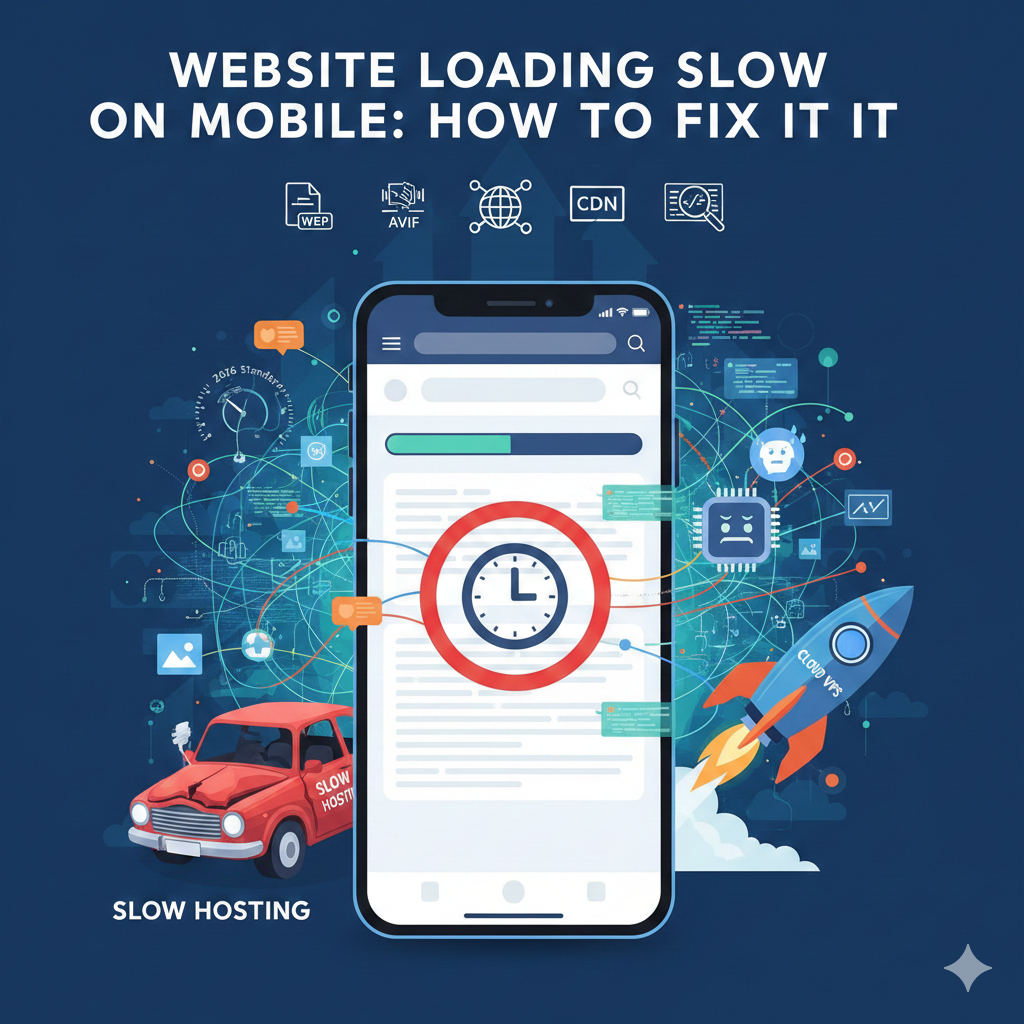
Do you have a snarling website on mobile devices? You’re not alone. The speed of mobile sites has emerged as an important criterion with regard to user experience, search position, and converting to customers. In the modern dynamic digital space, mobile users know that websites have to load within three seconds, and even a bit longer will cost you money and traffic.
User Comprehension: Understanding the Issue of Slow Mobile Sites.
Once having a website slow on mobile is the new problem, and it has a direct effect on your business. Research indicates that half of the mobile users have abandoned web sites that require a longer time of three seconds to load. In my five years of optimization and optimization of websites to work on mobile platforms, I have seen with my own eyes how the problem of speed can kill the conversion rates and user interaction.
Browsing on a mobile is very different compared to desktop. Mobiles have reduced processing capabilities, smaller caches, and in many cases are supported by cellular networks as opposed to a constant WiFi. Also, the mobile screens need dynamic aspect that is responsive to different sizes of the screen which further complicates the loading process.
Common causes include:
Images that were not optimized and that were not optimized to be seen in the phone use a lot of bandwidth. JavaScripts that delay the rendering of the pages do so annoyingly to the users. CSS and HTML code is not minified and this increases un-needed weight to your pages. Visitors are annoyed with slow response times of the servers that go beyond the acceptable limits. Absence of browser caching compels downloading of the same resources again. Mobile connections are too many HTTP requests. The third-party scripts and extensions that have not been optimized slow down performance.
The problem of your website slow on mobile device is the tip of the iceberg, when it has not been fixed despite simple optimization. The lack of proper hosting infrastructure, old content management systems, and poor database querying all add to the slow load time that sends away people.
True Story: The Price of Slow Mobile loading.
A client that I served last year had a mobile problem on his e-commerce website slow on mobile, which cost the company about 50,000 dollars every month in revenue lost. They had an average page load time of 8.2 seconds on their mobile devices and their bounce rate had shot to 68%. Having made extensive speed optimizations, we decreased the load time to 2.1 seconds, and in 3 months, we had grown mobile conversions by 127%.
This experience confirmed what Google research has continually revealed: the higher the page load time (between one and three seconds) the higher the bounce probability (32). It increases to 90 percent in one to five seconds. The effect of your website slow on mobile on real-life users is not just in terms of figures but directly in terms of money and brand image.
How to resolve the problem of slow mobile loading step by step.
1. Image Compression and Optimization.
Images occupy about 50-70 percent of the total weight of a webpage thus form the biggest culprit when website slow on mobile on mobile problems occur.
- Turn pictures into the new formats such as WebP which is better compressed.
- Serve responsive images with the help of srcset attributes in order to serve suitable sizes.
- Reduce compress images with such programs as TinyPNG or ImageOptim without any quality loss.
- Allow loading, which means that the images are loaded when the user scrolls.
- Establish definite attributes of width and height to avoid changes of layout.
2. Minimization and Deferral of JavaScript.
The use of JavaScript processing may be extremely detrimental to the website slow on mobile performance because of the restricted capabilities of the device.
- Compress all JavaScripts to eliminate extra characters and spaces.
- Delay the loading of non-critical JavaScript to after a basic first page load.
- Eliminate unused JavaScripts and libraries which are useless.
- Introduce code splitting and have scripts that needed only loaded per page.
- async attributes should be used on scripts that do not have an impact on initial rendering.
3. Optimize CSS Delivery
At times when your website slow on mobile is as a result of CSS errors, strategic optimization comes in handy.
- Non-between-the-world critical CSS.
- Compress CSS files to save space in files.
- Discard rules of CSS that add to your stylesheets.
- When it is necessary combine several CSS files to lessen the requests.
- Load media queries to load device type specific styles.
4. Enable Browser Caching
Caching will also ensure that repeat downloading will not occur in case the users visit your site again.
- Expire some of the static resources properly.
- Use versioning of the files that are being cached so that the updates are controlled.
- Utilize mobile advanced caching on mobile.
- Some settings on ETags should be configured to authenticate and verify the content of the cache.
- Use the CDN caching in delivering geographically dispersed content.
5. Reduce Server Response Time
When considering why your website slow on mobile still after frontend optimization, it is essential to consider the idea of backend optimization.
- Migrate to a faster hosting which has SSD storage and sufficient resources.
- Installing database query optimization and indexing.
- Apply server-side caching solutions such as Redis or Memcached.
- Unify HTTP/2 or HTTP/3 protocols, which are better in performance.
- Select data centers that are more geographically near your target audience.
- Maximize your content management system and eliminate redundant plugins.
6. Adapt Content Delivery Network (CDN).
A CDN will spread your content to servers all over the world, radically decreasing the loading time of your content on mobile.
- Choose a good CDN company that has got wide coverage across the world.
- Assign appropriate rules to the cache of various content.
- Automatically optimize the images using the CDN services.
- Adopt dynamic content acceleration to effect personalization.
- Check the performance of CDN on a regular basis in order to deliver optimally.
7. Maximize Mobile-Specific Aspects.
Considering mobile-specific considerations would frequently help explain why website slow on mobile performance on your site has a disproportionate effect on user experience.
- Use Accelerated Mobile pages (AMP) on sites that have a lot of content.
- Minimize or remove popup overlays that slack the creation of the rendering.
- Make mobile navigation simpler in order to reduce the complexity of the code.
- Optimize touch targets and interactive features to mobile gestures.
- Eliminate any animations that are not essential and use up processing resources.
Critical Mistakes to Avoid
The knowledge of what not to do is also valuable in troubleshooting the issue of the website slow on mobile. I have developed over the years of optimization, which I have found to be the common mistakes that, in fact, negatively affect performance.
Avoid these errors:
Mobile testing should not be overlooked and desktop performance should be given attention. Do not place desktop size images on mobile phones without optimizing them. Unnecessarily, avoid excessive use of client scripts or third-party scripts and plug-ins. Forget about routine performance audits and monitoring. Do not put in place measures without quantifying their effectiveness. Also please remember to test it in different mobile devices and networks. Do not ignore the influence of advertisements on the speed of loading. Resources above the fold that are used as render-blocking should not be used. Do not use complicated animations that put a lot of load on the mobile processors.
Measuring Your Success
Once you have fixed the problem of your site being website slow on mobile, the measurement proves that your work was worth it. Test the performance and get certain recommendations by using Google PageSpeed Insights. Use Chrome DevTools to find the points of slow down of the loading process. Track Core Web Vitals LCP, FID, CLS. Last Test on actual mobile devices with different network conditions. Waterfall analysis and performance indicators Can be looked at with WebPageTest.
Frequently Asked Questions
What should be the good mobile load time?
An average load time on mobile should be less than three seconds. Ideally, 1-2 seconds maximum is ideal to achieve maximum user experience and search ranking.
What is the impact of mobile speed on SEO?
Mobile page speed is one of the ranking factors at Google. The faster sites are prioritized, and they will have more organic traffic, and the user experiences are improved to enhance the engagement metrics.
Will it be possible to fix mobile speed without the assistance of a developer?
Simple optimization choices such as compressing images and minimizing the number of various plug-ins can be achieved separately. Nonetheless, advanced fixes such as minifying of codes and optimization of servers are normally done by technical knowledge.
Why are my websites slow on mobile as compared to desktop?
Mobile device processing power, cache memory, and cellular networks with lower latency at the expense of WiFi networks are lower, which is why optimization is important.
What should the frequency of testing mobile speed be?
Monitor mobile speed at least once a month and never when there are major changes or updates on the website to ensure that the performance is at optimum.
Will mobile speed be impacted because of website hosting?
Absolutely. Good hosting service with high speed servers, sufficient resources, and current infrastructure have a substantial influence on the speed at which users can access your mobile site.
Conclusion
The solution to a website slow on mobile needs to be thoroughly analyzed, and implemented in a strategic way and constantly monitored. After adhering to these evidence-based tips and tricks, you will be able to increase the performance of your mobile applications significantly, improve the user experience, and increase your conversion rates. It should be borne in mind that mobile optimization is not a one-task mission but rather a commitment to give your visitors the best experience possible, when it comes to their mobile devices. These solutions can be adopted today, which is why your performance in mobile will change.
If you are looking for reliable digital marketing services, get in touch with Digiteam for expert support.